

You do not need to spend hundreds of dollars to begin researching proprietary trading programs. However, choosing the cheapest prop firm challenge is not always the most economical decision. A low entry fee can come with restrictive trading rules, recurring charges, additional activation costs, or payout conditions that make a program less attractive than it first appears.
For traders working with a limited budget, the goal is to find a program that offers a reasonable entry cost without forcing them to compromise on risk management. That means evaluating the complete cost of participation, the rules governing losses, the account options available, and the conditions for receiving rewards.
This guide compares several prop trading firms from a budget-conscious perspective and explains how to avoid spending money on a challenge that does not fit your trading style.
What Does a Budget-Friendly Prop Firm Really Mean?
A budget-friendly prop firm is not necessarily the provider with the lowest advertised price. It is a provider whose total costs, evaluation requirements, and trading conditions make sense for your circumstances.
Consider three hypothetical offers:
- Program A has a low entry fee but charges a recurring subscription and a separate activation fee after passing.
- Program B costs slightly more upfront but has no recurring subscription.
- Program C advertises a large account and a high profit split but requires a trading style that does not match your strategy.
The lowest advertised price does not automatically make Program A the best value. Program B might be easier to budget for, while Program C could be unsuitable regardless of its potential reward.
Before comparing providers, separate your costs into four categories: the initial challenge fee, recurring charges, possible additional fees, and the conditions under which the original fee may be refunded.
Prop Firms Worth Comparing on a Limited Budget
The following shortlist focuses on established names and different evaluation approaches. The table is a practical comparison framework rather than an independently audited ranking. Actual fees depend on the selected account, currency, promotions, and current program terms.
| Rank | Prop Firm | Budget Advantage | Potential Trade-Off | What to Check Before Paying |
|---|---|---|---|---|
| 1 | The5ers | Multiple entry pathways and account structures to investigate | Costs and progression requirements differ by program | What is the full initial cost, including any payment due after passing? |
| 2 | FundingPips | Different challenge models for comparing entry prices | Loss limits and reward conditions vary between models | Does the cheapest model have restrictions that conflict with your strategy? |
| 3 | FundedNext | A range of evaluation formats and reward structures | Add-ons and product-specific terms can change the overall cost | What is included in the base fee, and what costs extra? |
| 4 | Leofins | One-time challenge fees starting from $59, according to its published pricing page | The fee is still at risk if the evaluation is unsuccessful; program rules differ | When is the fee refundable, and what are the drawdown and payout requirements? |
| 5 | FTMO | Structured evaluation options with published objectives | The appropriate challenge may cost more than some entry-level alternatives | Does the chosen account justify its cost for your trading experience? |
A provider’s appearance in this comparison is not a guarantee of suitability or future rewards. Before buying, verify the current terms of the exact program you intend to use.
1. The5ers: Compare the complete entry pathway
The5ers is worth investigating if you want to compare different evaluation and progression structures. The important budget question is not simply how little you can pay to begin, but how much the selected pathway costs from entry through the next stage.
Some programs may have different payment arrangements or progression conditions. Review the specific plan’s initial fee, any later payment obligations, evaluation targets, loss limits, and reward requirements before making a decision.
Budget tip: Calculate the total amount you could be required to pay, not just the first payment displayed on the pricing page.
2. FundingPips: Compare models before choosing the cheapest
FundingPips offers different challenge models, making it useful for traders who want to compare alternative evaluation structures. However, models can differ in profit targets, drawdown limits, and reward conditions.
A lower-priced challenge is not a bargain if its rules make your usual trading approach difficult to execute. Read the terms for the exact model and check whether optional features, resets, or other charges could increase your spending.
Budget tip: Compare two or three models using the same checklist instead of choosing the first discounted offer you see.
3. FundedNext: Look beyond promotional pricing
FundedNext provides multiple evaluation formats and reward arrangements. For a budget-conscious trader, the main task is to establish what the advertised price covers and which conditions apply after passing.
Review the evaluation objectives, drawdown rules, reward eligibility, and any paid options that change the account conditions. If a promotion is available, confirm its expiration date and whether the advertised price applies to the account size you want.
Budget tip: Treat optional upgrades as additional expenses, not as necessary purchases. Pay for them only if you understand their practical value.
4. Leofins: Evaluate the upfront fee and ongoing costs
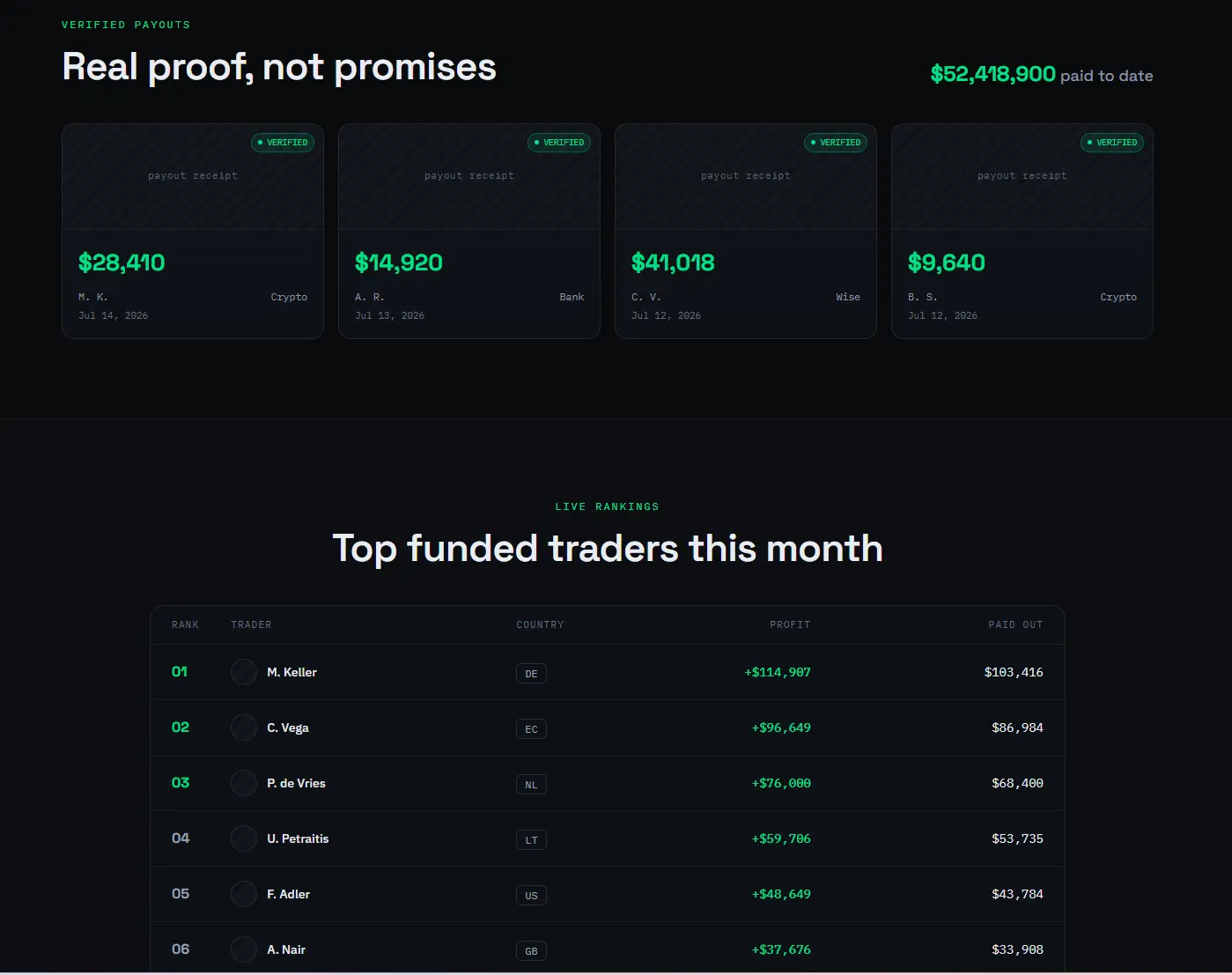 Leofins offers several CFD evaluation formats: Core 2-Step, Edge 1-Step, and Starter 3-Step. Its published pricing page lists challenge fees starting from $59, with the exact price depending on the selected program and account size. The company also advertises no recurring subscription, platform, or withdrawal fees, although payment providers and currency conversion can involve their own costs.
The three evaluation formats have different targets and loss limits. Core uses two phases, Edge uses one phase, and Starter uses three. The entry fee should therefore be considered alongside the rules you must follow to complete the evaluation.
Leofins states that the challenge fee is refunded in full with the first reward payout for Core and Starter, and with the second reward payout for Edge. This is conditional on meeting the relevant requirements; it should not be treated as a guaranteed refund for every purchaser.
Review the current terms at www.leofins.com before deciding. Confirm the exact fee, drawdown calculations, minimum trading days, payout eligibility, and whether the selected account supports the markets you intend to trade. The evaluation and funded stages are simulated, and passing does not guarantee future rewards.
Budget tip: A clear fee structure can make expenses easier to plan, but only choose the program if its risk limits and trading conditions fit your strategy.
5. FTMO: Consider the value of the evaluation structure
FTMO is another provider worth comparing when researching evaluation requirements and account conditions. It offers different challenge formats, so you should assess the exact option rather than assume every program has the same price or objectives.
For a trader on a limited budget, the relevant question is whether the cost is reasonable relative to the program’s rules and the trader’s readiness. A well-known name does not eliminate the possibility of failing a challenge and losing the fee.
Budget tip: Do not pay a premium simply because a provider is familiar. Compare its terms against at least two alternatives.
The Four Costs to Calculate Before Buying
A realistic budget should include more than the amount shown beside a challenge button.
Initial evaluation fee
This is the upfront amount paid to enter the challenge. It may vary according to account size, evaluation model, currency, and current promotions.
Before paying, confirm the final amount at checkout. Avoid basing your budget on an old screenshot, a third-party discount listing, or a price associated with a different account.
Treat the initial fee as money you may lose. A fee refund, where offered, normally depends on meeting specified conditions and reaching a qualifying payout stage.
Subscriptions and activation charges
Some programs use recurring subscriptions, while others charge a one-time fee. Certain models may also require an additional payment to activate a subsequent account after passing the evaluation.
These costs matter because they change the amount you need to set aside. A challenge advertised at a low monthly price may become expensive if you need several months to complete it. A one-time fee may be easier to plan around, but it can still be lost if you fail.
Write down every required payment and when it becomes due. If a pricing page does not make the total clear, request clarification before purchasing.
Resets and repeat attempts
A reset or discounted restart may be available after a failed challenge, depending on the provider and program. It is tempting to view this as a convenient way to try again, but repeated payments can quickly exceed your original budget.
Before buying, decide how much you are willing to spend on evaluation attempts. If you fail, review your trades and identify the cause before considering another purchase. Repeating the same approach without correcting the problem is unlikely to improve your prospects.
Trading and withdrawal-related costs
Even when there is no subscription or withdrawal fee, other costs may apply. Depending on the program, these can include trading commissions, spreads, swaps, currency conversion, or charges imposed by a bank or payment service.
These costs may be small individually but still matter to strategies that trade frequently or operate with narrow profit targets. Check the instruments and account conditions you intend to use rather than relying on a general statement that a program has low fees.
Account Size: Why Bigger Is Not Always Better
A larger advertised account can make a program appear more attractive, but it does not necessarily provide more usable risk capacity. Your actual trading flexibility is determined by the drawdown limits and other account rules.
Suppose two simulated accounts use different nominal balances but have different maximum loss allowances. The larger balance may not be the better option if its fee is substantially higher or if the risk limits make it unsuitable for your strategy.
Beginners should focus on three questions:
- Can I afford the entry fee without affecting essential expenses?
- Can my normal position size fit within the program’s daily and overall loss limits?
- Does the larger account meaningfully improve the program’s suitability for my strategy?
Choose the smallest option that meets your requirements, provided its rules and costs make sense. There is little benefit in paying for a larger nominal account if you cannot trade it comfortably within the rules.
How to Compare Drawdown Rules Without Making Costly Mistakes
A cheap challenge can become expensive if its rules are poorly understood. Drawdown calculations deserve particular attention because they determine when an account may breach its limits.
Daily loss limits
Daily limits restrict how much an account can lose within a defined trading day. Providers may calculate these limits from starting balance, equity, or another specified reference point. Some calculations include unrealized losses on open positions.
Check the reset time, the applicable time zone, and whether commissions or floating losses count. A trader who does not understand these details may breach a rule even without deliberately exceeding a planned closed-trade loss.
Maximum drawdown
Maximum drawdown sets the broader loss boundary. Some programs use a static threshold, while others use trailing calculations that may change as the account reaches new levels.
Do not compare percentages alone. A 10% static maximum loss and a 10% trailing drawdown can behave very differently. Read the actual calculation method and test how it would affect your position sizing before paying.
Profit targets and consistency rules
A low fee does not compensate for an unrealistic target. Consider whether you can pursue the required profit without increasing risk beyond your established plan.
Some programs also impose consistency requirements or rules concerning the contribution of a single profitable day. These conditions can influence how you trade and whether you qualify for rewards. Make sure you understand them before treating a program as affordable.
One-Step, Two-Step, or Three-Step: Which Offers Better Value?
The number of evaluation stages is one factor in the total comparison, but it does not determine the best value on its own.
One-step challenges generally use a single evaluation phase. They may appeal to traders who prefer a shorter evaluation structure, but their targets and risk limits can differ from those of multi-step alternatives.
Two-step challenges divide the evaluation into two phases. Each phase has its own objectives, and you need to comply with the applicable rules throughout the process.
Three-step challenges divide the process into more stages. This may spread the evaluation across separate targets, but the combined requirements and account conditions still determine how demanding the program is.
To compare value, record the fee, targets, daily loss limit, maximum drawdown, minimum trading days, time limit, and payout conditions for each option. Then assess whether the requirements match your strategy.
Do not choose a format solely because it appears faster or cheaper. The most economical option is one you can approach realistically without changing your risk management to chase a target.
A Simple Budget Plan for Your First Prop Challenge
Before purchasing an evaluation, establish a firm spending limit. The following approach can help keep the decision grounded.
First, set your maximum budget. Decide what amount you can afford to lose entirely. Do not include rent, debt payments, emergency savings, or money needed for everyday living.
Second, shortlist a few programs. Compare the full fee structure, account rules, supported instruments, and payout requirements. Avoid researching dozens of providers without first defining your needs.
Third, test your strategy. Practise in a demo environment and record your results. Your aim should be to demonstrate consistent rule-following, not simply to produce a few profitable trades.
Fourth, calculate the complete cost. Include the challenge fee and any required recurring, activation, or trading-related charges. Treat optional resets as potential additional spending rather than part of the original plan.
Finally, set a stopping point. Decide in advance how you will respond to a failed evaluation. If you breach a rule, pause and review the reason rather than immediately purchasing another challenge.
A spending plan cannot guarantee that you will pass, but it can prevent the cost of repeated attempts from growing without control.
Frequently Asked Questions
Are the cheapest prop firms always the best for beginners?
No. A low fee can be attractive, but the evaluation targets, drawdown rules, additional charges, and payout conditions are just as important. Choose a program that fits your strategy and budget rather than focusing on price alone.
Can I get my challenge fee back?
Some providers refund evaluation fees after specific milestones or qualifying payouts. Others may not offer a refund for the selected program. Check the current terms and understand exactly when the refund becomes available. Do not count on receiving it if you have not yet met the conditions.
Should I buy a larger account if it costs only a little more?
Not automatically. A larger nominal account may have a higher fee and different risk implications. Compare the loss limits, trading requirements, and total cost before deciding whether the additional account size is useful.
Are recurring subscriptions worse than one-time fees?
Neither structure is inherently better. A subscription can become expensive if the evaluation takes a long time, while a one-time fee can still be lost after an unsuccessful attempt. Compare the total amount you could pay under realistic scenarios.
Is it worth paying for resets or upgrades?
Only if you understand the feature and have a clear reason to use it. Additional payments should not become a way to avoid reviewing mistakes or to justify taking more risk. Check whether the feature is optional and whether the program can be used without it.
How can I avoid spending too much on prop challenges?
Set a fixed budget, practise before purchasing, understand the rules, and review every failed attempt before paying again. Never use money required for essential expenses, and do not assume future rewards will cover your costs.
Make the Budget Fit the Trading Plan
A sensible prop trading budget starts with the trader, not the advertised account. Establish how much you can afford to lose, choose the markets you understand, and compare the complete cost of several programs. Then examine drawdown rules, evaluation targets, and payout conditions before making a decision.
The cheapest entry fee may not provide the best value, and the largest account may not be the most suitable. A program is worth considering only when its terms are clear, its costs fit your budget, and its rules allow you to follow a disciplined strategy without taking unnecessary risks.
Prices and conditions are current as of October 2026.
Risk disclaimer: Proprietary trading evaluations involve financial risk. Challenge fees may be lost if an evaluation is unsuccessful or program rules are breached. Simulated trading and funded-program results do not guarantee future performance or income. Review the current terms carefully and never spend money you cannot afford to lose.